

Rare Disease Genomics

The average rare disease patient waits four to eight years for a confirmed diagnosis. Front and back-end teams often grapple, cycling through misdiagnoses, repeat tests, and new specialist referrals. In most cases, the causal variant already exists in sequencing data.
At ClairLabs, we are aware that the bottleneck is not the genome. We help health and clinical leaders elevate the speed, depth, and consistency of interpretation with our rare disease workflows.
Transformative Consulting Offerings

We design and optimize end to end NGS pipelines, automating QC, variant calling, annotation and regulatory grade reporting. Harmonize multi-omics data and migrate bioinformatics to cloud-native platforms for reproducible diagnostics.

We build HIPAA and GDPR compliant data lakes, that enable firms to migrate their legacy systems to cloud microservices, implement FHIR, HL7, OMOP and GA4GH interoperability. Enable federated learning to train secure cross institutional AI.

We advise labs on LIMS and ELN modernization. We also design API first microservices to replace monoliths, craft clinician friendly UX, dashboards, and AI copilots that streamline workflows and accelerate decision making.

We design infrastructure and workflows meeting HIPAA, GDPR, CLIA and CAP. Implement auditability, logging, governance; apply threat modeling, encryption and secure APIs to protect patient genomics and clinical data at scale.

We implement AI diagnostic systems for variant interpretation, risk stratification, and predictive modeling. Integrate Gen AI for literature synthesis and matching. Leverage agentic workflows and digital twins to personalize and accelerate decisions.
Offerings and Key Features

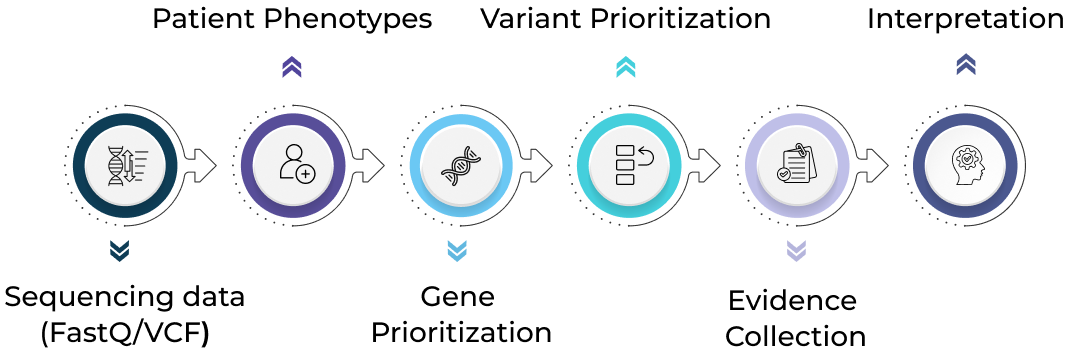
Accepts FASTQ/VCF from WGS, WES, and targeted panels inputs across cloud-native and hybrid environments. Automated QC and alignment run without manual configuration, thus supporting probands, family, and large cohorts reproducibly.
.png?width=58&name=Vector%20(1).png)
Clinical teams enter symptoms using HPO-linked terms, mapped in real time to OMIM, HPO, and other curated sources. Gene candidates surface ranked by phenotype relevance even before the variant list is reviewed.
.png?width=52&name=Vector%20(2).png)
Our advanced ML model scores each variant for pathogenicity probability and ranks candidates with supporting annotations and evidence from 40+ sources, including ClinVar, LOVD, population databases like gnomAD, along with proprietary South Asian-specific MAF and reported variants – giving analysts a complete picture, not a raw score.
.png?width=55&name=Vector%20(3).png)
Automated ACMG classification applies to PVS1, PS1, PM2, and all standard evidence rules to every variant. CNVs are classified as per Clingen-ACMG. Curators retain full override capability, and every decision is logged for audit and compliance.

.png?width=60&name=AI%20and%20ML%20(1).png)
How Do We Stand Apart from Competitors?

Intelligence
Impactomics starts with the patient's clinical presentation and not the variant list. HPO profiles, OMIM, ClinGen, and Orphanet drive prioritization before manual review begins.

at Variant Level
For every candidate variant, Impactomics auto-generates an explainable evidence summary, drawing on ClinVar, PubMed, ClinGen, and functional studies, so that analysts review conclusions rather than raw sources.

Classification
Every ACMG criterion is backed by source evidence, applied logic, and supporting data. No black-box labels, ensuring full auditability for CAP/CLIA-compliant sign-out.

Analysis
Singleton, duo, trio, and extended pedigree analyses run natively, including de novo detection, compound heterozygosity, and segregation evidence, are resolved without external tools or manual data merging.

Quality Verification
Integrated BAM assessment agents evaluate read depth, allele balance, strand bias, and mapping quality. Flag potential artifacts before interpretation, reducing false positives at the source.

Knowledge Graph
Impactomics connects patient phenotypes, genes, diseases, variants, literature, and clinical evidence into a single dynamic graph. Teams find clinically relevant associations that simple variant filtering consistently misses.
What Leaders Can Expect

(CMOs, Clinical Geneticists, Compliance Officers)
Deploy a genomics platform that meets HIPAA, GDPR, and CAP/CLIA requirements from day one – without a separate compliance implementation project or

(Lab Directors, Quality Managers, IT Leaders)
Enforce consistent access controls, reproducible workflows, and full audit trails across every case, fulfilling regulatory inspections and internal quality reviews without additional documentation overhead.

(Research Heads, Data Stewards, Bioinformaticians)
Operate across institutional and cross-border data environments with confidence. Data residency controls and FHIR/HL7-compliant exports keep research programs aligned with
Related Solutions
.jpg?width=300&name=048fe5e71d05e92b27c3f32758269d2404fe5aff%20(1).jpg)
Deploy containerized NGS workflows on cloud-native infrastructure. Automate variant calling, annotation, and reporting for high-throughput genomic diagnostics and research.

Deploy containerized NGS workflows on cloud-native infrastructure. Automate variant calling, annotation, and reporting for high-throughput genomic diagnostics and research.
Deploy containerized NGS workflows on cloud-native infrastructure. Automate variant calling, annotation, and reporting for high-throughput genomic diagnostics and research.

Ready to surface the casual variant faster?