

.svg)
Women’s health has become a high-priority topic in research and policy, but trial design still lags behind the need. Women’s health trials still face a representation problem. A 2024 study reaffirmed that women remain underrepresented in medical device trials, and a 2025 JAMA Network Open study noted that women remain underrepresented across several major trial areas, including cardiology, surgery, emergency medicine, and oncology. That weakens the generalizability of evidence and slows the development of treatments that truly reflect women’s needs.
For sponsors, this is not just a matter of fairness. It is a feasibility issue. When women’s health clinical trials struggle to recruit the right patients, timelines slip, screen failures rise, and the resulting dataset becomes harder to use commercially or clinically. That is why data-driven recruitment is now central to trial strategy rather than a support function.
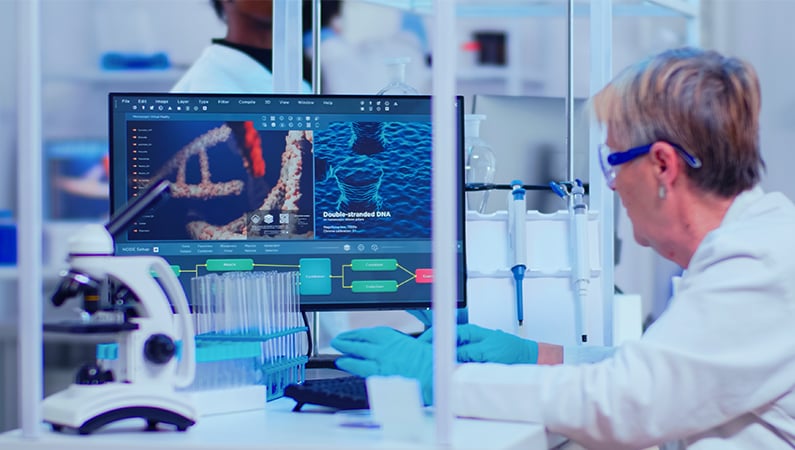
Patient Recruitment Is Now a Data Problem, Not Just a Site Problem
Site teams are already telling the industry that trial complexity and recruitment are the top pain points. The escalating complexity of clinical trials was identified as the most common site challenge in a recent study, while WCG’s 2024 report showed that recruitment and retention remain major issues across site populations. That is a strong signal that manual workflows alone cannot keep up.
This is where AI for clinical trials and AI-powered protocol feasibility platforms start to matter. AI in clinical trials reported that one AI system reduced screening time from an average of 8 hours per patient to 30 minutes, while in another use case, AI can improve recruitment and retention by making matching more efficient and less manual. In other words, the industry already has proof that better matching is possible when data is connected well.
Why Multi-omics Matters Most in Breast and Ovarian Cancer Trials
The most difficult recruitment problems often show up in breast and ovarian cancer trials, where eligibility can depend on a mix of germline markers, tumor features, prior therapy, clinical history, and sometimes broader molecular signatures. Nature’s 2024 perspective on women’s reproductive health highlights how newer data sources, such as next-generation sequencing and electronic medical records, are expanding what researchers can see, while also stressing that representation gaps and data completeness still remain.
That is why multi-omics recruitment is such an important capability. It does not mean adding complexity for its own sake. It means using molecular and clinical context together so trial teams can pre-screen with more precision. In this environment, multi-omics recruitment is a practical way to enrich cohorts, reduce mismatches, and accelerate enrollment in women’s health clinical trials.
Impactomics Gives Recruitment Teams a Governed Starting Point
This is where Impactomics becomes strategically useful. In your draft, the platform is framed as a governed environment that unifies genomics, proteomics, metabolomics, and clinical data while supporting secure analytics, APIs, and integration. That architecture matters because recruitment models fail when data is fragmented or unreliable. A clean backbone makes it easier to run AI-driven data cleaning and discrepancy management in trials before those issues affect enrollment.
For women’s health clinical trials, this means trial teams can connect EHR, claims, and omics data in one place and use Impactomics to support pre-screening, cohort enrichment, and traceable decision-making. The same backbone also helps CROs and sponsors maintain governance as they scale data-driven recruitment across multiple sites and studies.
Three Use Cases Where Richer Cohorts Become Possible
A useful way to think about the opportunity is through workflow, not theory. In a hereditary breast or ovarian cancer study, Impactomics can help integrate genomic results with family history, treatment history, and clinical notes, enabling the recruitment team to identify likely matches earlier.
In a precision oncology study, it can combine molecular signatures with prior therapies to support more targeted pre-screening.
In a broader women’s health program, it can help teams build more representative cohorts by linking claims, EHR data, and demographic context into one governed view.
These are the kinds of use cases where AI-powered protocol feasibility platforms become valuable. They help teams test eligibility logic against real-world populations before a study gets stuck. They also give trial leaders a more operational answer to a strategic question: Are we recruiting the right participants fast enough to support the science?
Decentralization Helps, But Only When the Data Layer Is Ready
The FDA’s guidance on decentralized clinical trial elements says remote participation can improve convenience, reduce burden, and support better engagement, recruitment, enrollment, and retention for more representative populations. That is especially relevant in women’s health, where access barriers, caregiving demands, and geography can affect participation. (U.S. Food and Drug Administration)
That said, decentralization is not a magic fix. It works best when CDM systems supporting decentralized (DCT) and hybrid trials are connected to strong governance, interoperable data flows, and clear consent handling. That is why cloud engineering, APIs and integration, and GenAI services matter here. They help trial teams move from manual coordination to a more responsive operating model.
Towards More Inclusive, Intuitive Trials
The next phase of women’s health clinical trials will belong to teams that recruit more precisely and with less friction. That means using AI for clinical trials, designing better data-driven recruitment workflows, and grounding everything in a platform like Impactomics that keeps data secure, usable, and traceable. In a market where underrepresentation still shapes outcomes, richer cohorts are not just operationally better. Rather, they are scientifically stronger!